
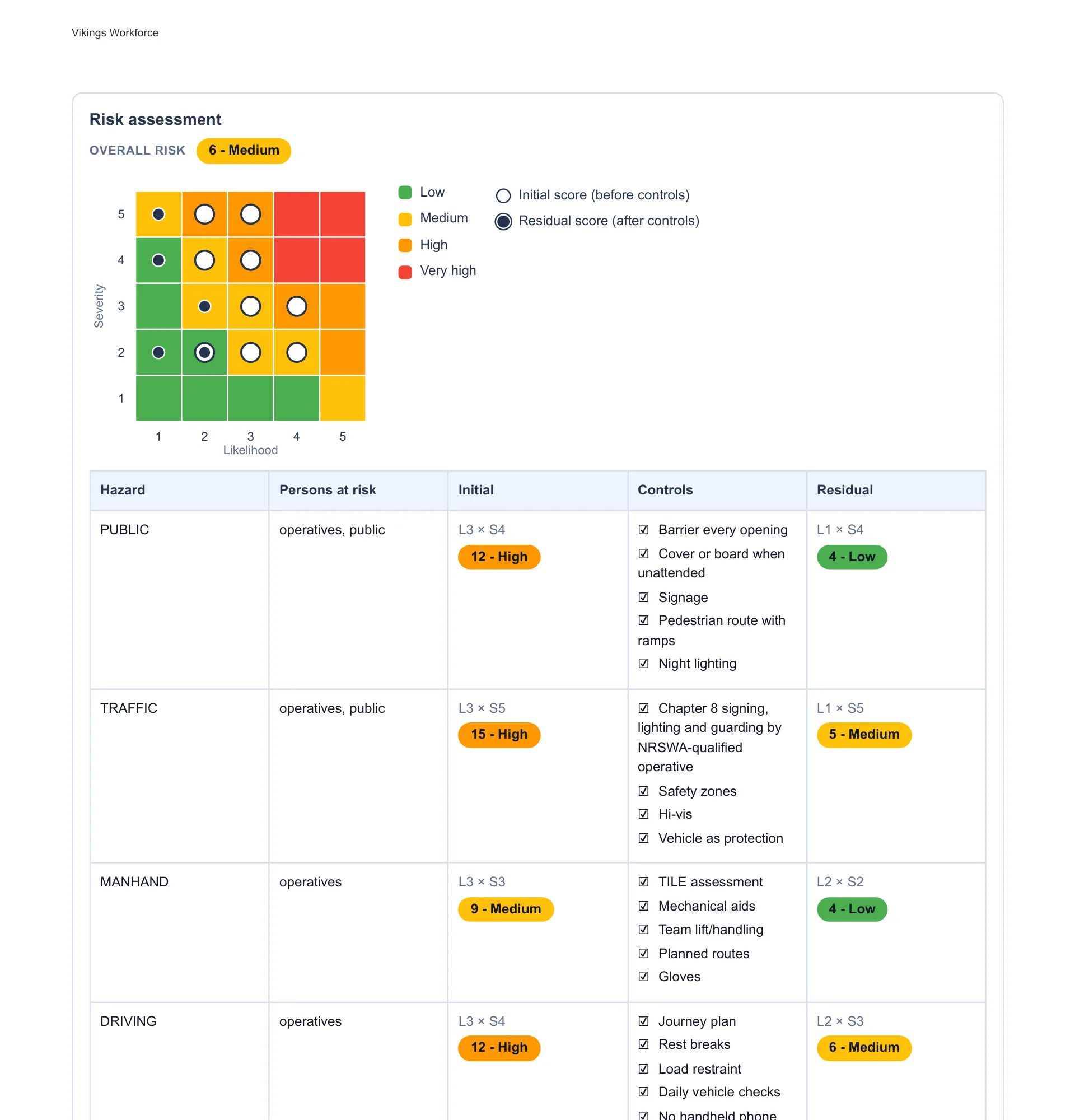
Point-of-work assessment
Crews score the risks they face on site.
Hazards and controls come from your own library.
Score point-of-work risk assessments from your own hazard and control library. Record toolbox talk attendance signatures, lone-working check-ins and controlled documents with read receipts in one evidence chain.

Four safety moments
Four moments where a safety decision or acknowledgement becomes a record.
Crews score the risks they face on site.
Hazards and controls come from your own library.
People sign where the briefing happens.
The attendance record stands up later.

A worker records the expected check-in.
Escalation follows when a check-in is missed.

A controlled document reaches the right crew.
Read receipts show who acknowledged it.
What management gets
In practice
Each control produces a record at the moment it matters, so a review does not depend on someone reconstructing the day.
Point-of-work risk assessments are scored against your own hazard and control library, so crews choose from the risks and controls your operation actually deals with. A generic template invites tick-box completion; a familiar one gets read.
Toolbox talks capture attendance signatures where the briefing happens, in front of the people who were there. Weeks later the attendance record still shows who was briefed on what, without needing a paper register to have survived the van.
Controlled documents carry read receipts against the current version. When a method statement or policy is revised, you can see who has acknowledged the new one rather than assuming the update reached everybody.
A lone worker records an expected check-in before starting. If the check-in is missed, escalation follows, and the session history stays available afterwards so the response can be reviewed like any other safety event.
Keep the chain connected
Review your safety process